
Products
Work Tainer
A work tainer is a wheeled cage used to organise and move goods within a suitable warehouse, stockroom or retail route. Hyperack’s published examples use steel frames or mesh with fixed and swivel-wheel arrangements. Confirm the exact model, load arrangement, closure, wheel and brake equipment for your goods and operating conditions.
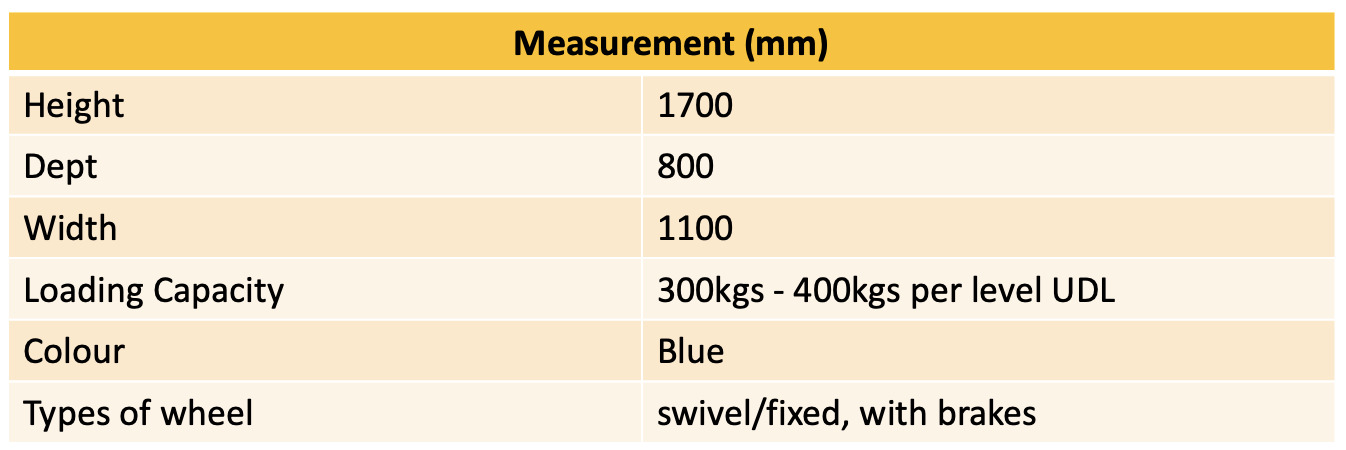
Two published dimension references
The page graphic and the catalogue example (PDF p.80, printed p.79) show different dimensions. Match the quotation to the actual unit; these references should not be averaged or assumed interchangeable.
| Published reference | Height (mm) | Depth (mm) | Width (mm) |
|---|---|---|---|
| Page dimension graphic | 1700 | 800 | 1100 |
| Catalogue example | 1730 | 780 | 1080 |
Both references list 300–400 kg per level UDL. UDL means uniformly distributed load. Confirm the permitted load on each level and the complete mobile unit, including its wheel and chassis limits and the conditions for movement. The published per-level range is not a total-unit rating obtained by multiplying the range maximum by the number of shelves.
Prepare a work tainer enquiry
- Goods dimensions, total mass, load distribution and number of shelf levels required
- Model or dimension reference, door or side arrangement, and any requested accessories
- Loaded route, doorways, turning space, floor joints, gradients and thresholds
- Wheel and brake requirements, operating environment and any cleaning conditions
- Whether folding, internal transfer or vehicle delivery is required, with the relevant handling and restraint arrangements
Ask Hyperack to confirm the actual unit specification, operating instructions and supplied scope. Contact the team with your goods and route details.
Ideal for
- Internal stock movement where the loaded unit and route have been assessed
- Goods organisation within a stockroom or warehouse using the specified level and unit limits
- Retail replenishment with sufficient customer separation, clearance and turning space
- Department transfers where goods, cleaning and operating conditions suit the selected unit
- Delivery staging where the proposed loading, vehicle and restraint arrangements are confirmed
Advantages
- Published steel-frame or mesh units with the actual finish and load limits confirmed
- Wheel and brake arrangements selected for the loaded route and operating conditions
- Folding available where the selected model and its instructions permit it
- Goods organisation matched to the shelf arrangement, packaging and unit capacity
- Door, closure or restraint options confirmed as part of the supplied configuration
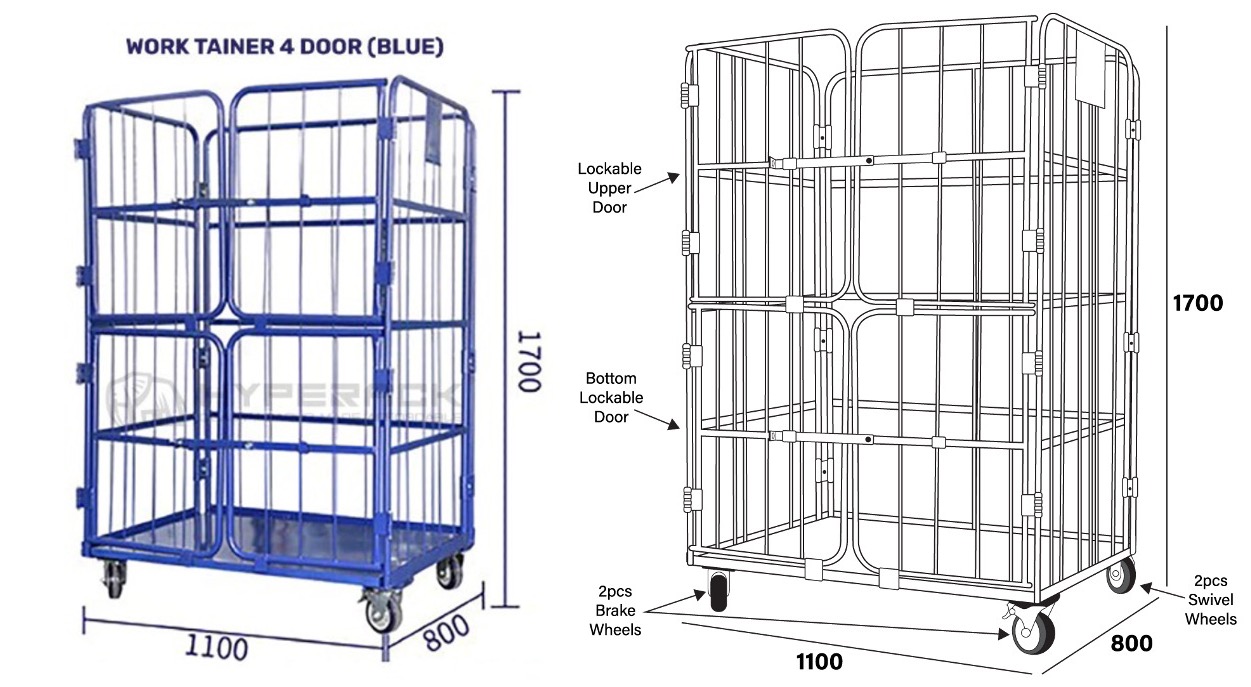
Standard Work Tainer
The standard style illustrated on this page uses a wheeled cage arrangement. Confirm its dimensions, door or closure equipment, brakes and overall permitted load on the quotation; visible features in a photograph do not establish the rating of every supplied unit.
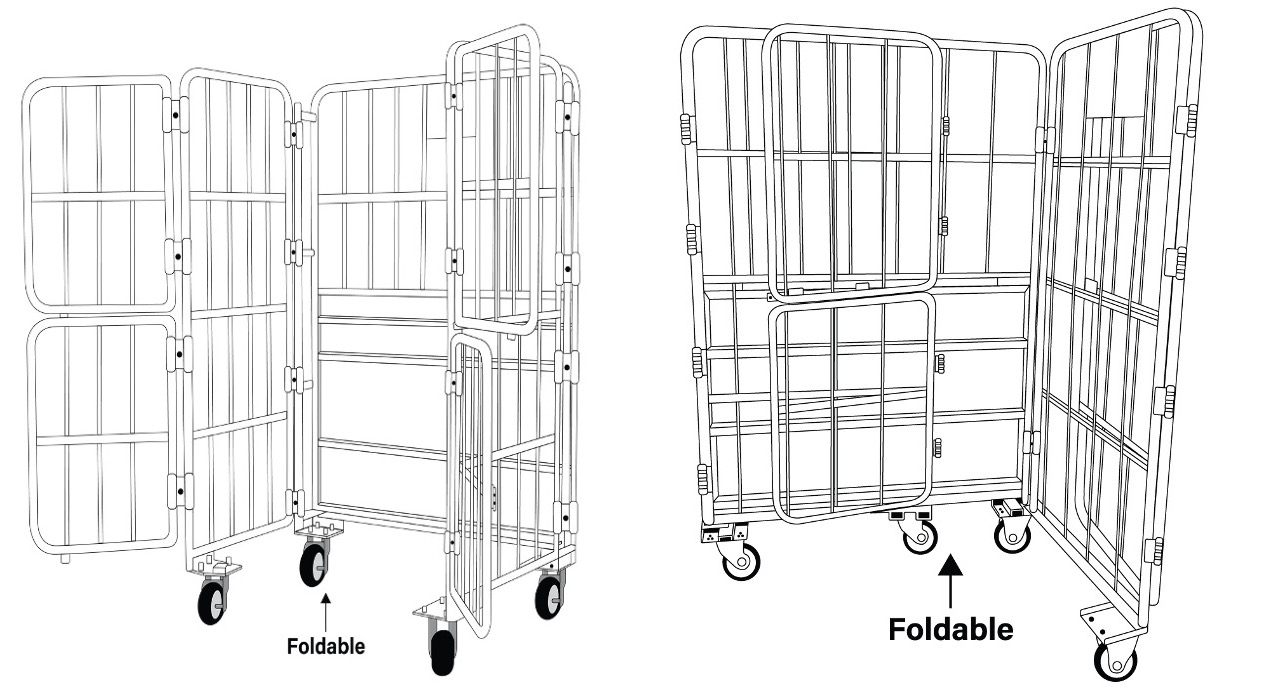
Space-Saving & Flexible Storage
The foldable style is intended to reduce the space occupied when the unit is empty and stored according to its instructions. Confirm the actual folded dimensions, folding procedure and locking or retention requirements for the model being quoted.
5 Easy Steps
1. Enquiry
Your journey begins with a simple enquiry. Once we receive your request, our team will review the details and match you with the right expert. We’ll then arrange a quick call or email to learn more about your goals and expectations.
2. Free Consultation
After your initial consultation, we’ll arrange a site visit to assess your space and needs in detail. You’ll meet your dedicated project manager, who will guide the process from start to finish—ensuring everything runs smoothly and efficiently.
3. 3D CAD Design
After the site survey, your project manager will recommend layout options tailored to your space and needs. We’ll then create accurate 3D CAD designs to help you visualise exactly how your facility will look once complete.
4. Instant Quote
You’ll receive a free, personalised quote with a full breakdown of the recommended equipment. We offer high-quality products at competitive prices, with reliable delivery times to keep your project on schedule.
5. Installation
We’ll agree on an installation schedule that suits your operations. Our accredited team will complete the setup, conduct a final inspection with you, and provide follow-up support, including annual safety checks.
Ready to make a change?
We are here to help you choose the best racking for your business. Schedule a call with our representative today.
FAQ
What industries benefit the most from using Work Tainers?
Work tainers may suit internal stock movement and temporary goods organisation where the selected unit matches the loads, route and environment. Describe your warehouse, retail or production task, including any cleaning or product-protection requirements. An industry label alone does not establish that a particular cage, wheel or finish is suitable.
Why should I use Work Tainers instead of traditional trolleys or carts?
- Load comparison: Compare the rated level and whole-unit limits of the actual cage and trolley for your goods.
- Storage arrangement: Check the shelf layout and whether the selected empty unit can fold or nest under its instructions.
- Goods retention: Confirm the doors, sides, packaging and any separately specified restraints needed for the load.
- Route and wheels: Assess the loaded footprint, turning space, floor conditions, wheel arrangement and brakes.
How do Work Tainers improve efficiency in a warehouse or retail environment?
A cage can group goods for a suitable handling task, but the number of trips and the effort required depend on the load, route, packing and operating method. Compare the proposed unit with your current process using the same goods and movement requirements. Do not assume a particular time, labour saving or safe push force from the presence of wheels alone.
Are Work Tainers suitable for use in narrow aisles or tight spaces?
Measure the loaded unit and the actual route, including doorways, aisle junctions, thresholds, floor condition and turning space. The two published dimension references on this page differ, so confirm the dimensions of the quoted model. Assess how operators and other people will be separated from the movement; a compact-looking photograph does not establish clearance.
Can Work Tainers be folded and stored when not in use?
The page illustrates a foldable style, and the catalogue also describes a folding arrangement. Confirm whether the selected unit folds or nests, its empty stored dimensions and the required sequence and retention points. Follow the model’s instructions and keep hands clear of folding joints; do not assume that every work tainer has the same mechanism.
What materials are Work Tainers made from?
Hyperack’s published examples use steel frame or mesh construction. Confirm the actual material, protective finish, shelf or base material, wheel material and brake equipment in the quotation. Ask whether that specification suits the cleaning, moisture, temperature and exposure conditions of your operation.
Can Work Tainers be customized to suit specific needs?
Describe the goods, shelf arrangement, doors or closure, restraint needs and any other requested features. Hyperack can confirm what is available for the selected unit and how those options affect its dimensions and permitted loads. Treat extra shelves, straps or branding as quoted scope rather than assuming they are included.
Do Work Tainers help reduce product damage during transport within the warehouse?
Mesh sides or closures can help contain suitable goods, but packaging, load distribution, stack stability and the required restraints still need assessment. Confirm the permitted load arrangement and closure instructions for the unit. Fragile or small items may need appropriate containers or protection; a cage alone does not guarantee damage-free movement.
Are Work Tainers suitable for delivery or stock transfer between branches?
Confirm whether the selected unit is suitable for the proposed loading equipment, vehicle and delivery route. Assess ramps, thresholds, tail-lift or loading-platform limits, vehicle restraint points and the handling procedure. Internal rolling suitability does not by itself establish safe vehicle transport or securement. Follow the unit, loading-equipment and vehicle instructions for the actual operation.