

Products
Stacker
A stacker lifts and positions palletised loads using a mast and forks. Choose the equipment around the loaded pallet, required lift height, handling frequency and available operating space. Confirm whether travel and lifting are manual or powered on the actual model being quoted; those functions affect operator effort and the working method.
Moving a pallet at floor level or bringing goods to working height? Compare pallet jacks, stackers and lift tables before choosing a model.
Hyperack’s published stacker catalogue page lists SPE1016 and SPE1030. The comparison below transcribes selected catalogue labels; it does not confirm current stock or the specification of a particular unit.
On a phone, swipe the model comparison sideways.
| Catalogue label | SPE1016 | SPE1030 |
|---|---|---|
| Published capacity label (kg) | 1000 | 1000 |
| Minimum fork height (mm) | 88 | 85 |
| Maximum fork height (mm) | 1600 | 3000 |
| Minimum mast height (mm) | 2078 | 2080 |
| Fork length (mm) | 1150 | 900 |
| Overall fork width (mm) | 800 | 300–640 |
Doorway example. The catalogue minimum mast heights of 2,078 mm (SPE1016) and 2,080 mm (SPE1030) both exceed a 2,000 mm clear opening. Measure the lowest overhead obstruction on your route and confirm the clearance needed for the quoted unit and load.
Both catalogue models carry a 1000 kg capacity label, with different maximum fork heights and fork dimensions. That label does not establish 1000 kg capacity at every lift height, load centre or attachment configuration. Ask for the selected unit’s load chart and operating instructions, and confirm pallet entry, fork and support-leg clearance, mast clearance and manoeuvring space before ordering. The catalogue battery heading is ambiguous, so electrical and charger details also need model-specific confirmation.
Ideal for
- Pallet stacking where the selected model’s documented load and lift requirements match
- Material handling with confirmed pallet entry and fork or support-leg clearance
- Backroom or distribution tasks with adequate manoeuvring and operator space
- Routes checked for floor condition, doorway and overhead clearance
- Handling duties matched to the chosen travel, lifting and training arrangements
Advantages
- Positions compatible pallet loads at the documented lift height
- Offers model-specific fork and mast dimensions to compare with the site
- Can replace manual lifting within a suitable handling process
- Allows manual or powered functions to be specified for the required duty
- Supports equipment selection against load charts, operating instructions and service scope
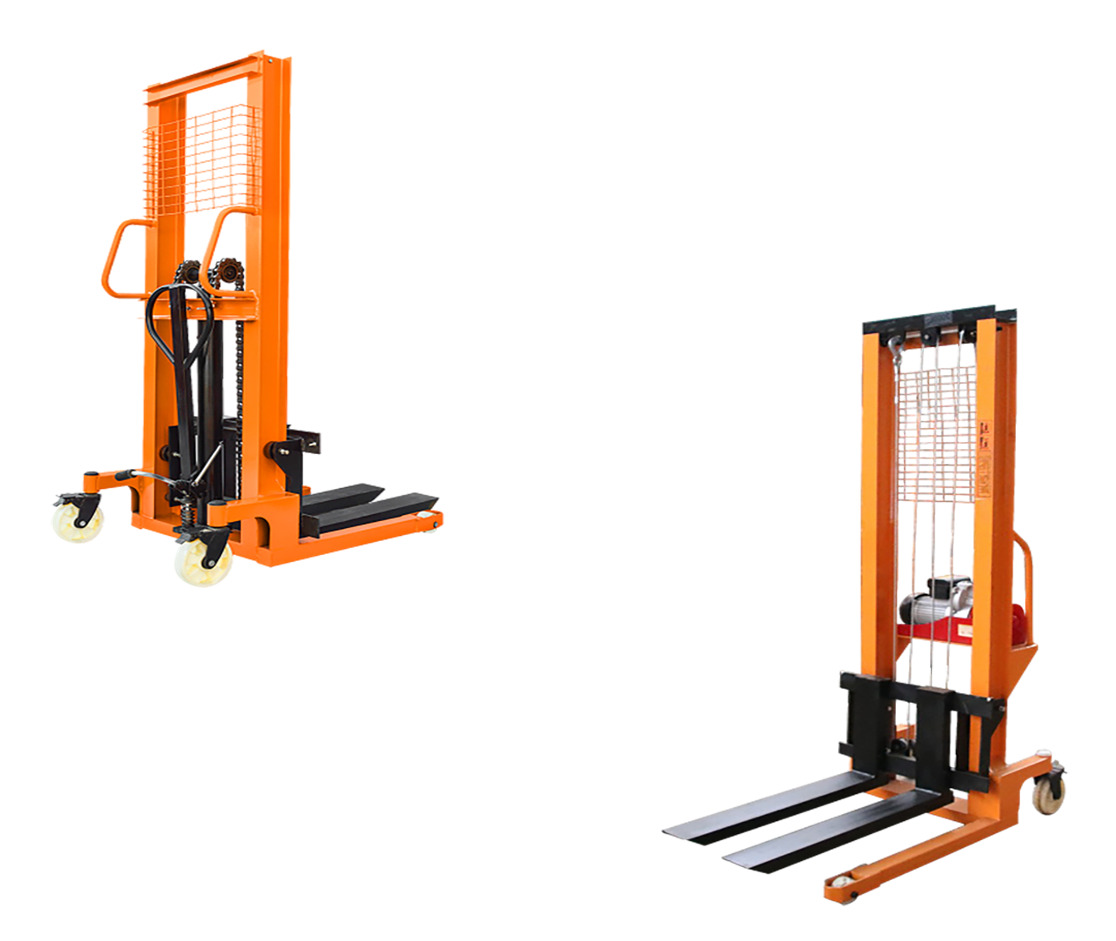
Manual / Semi-Electric Stacker
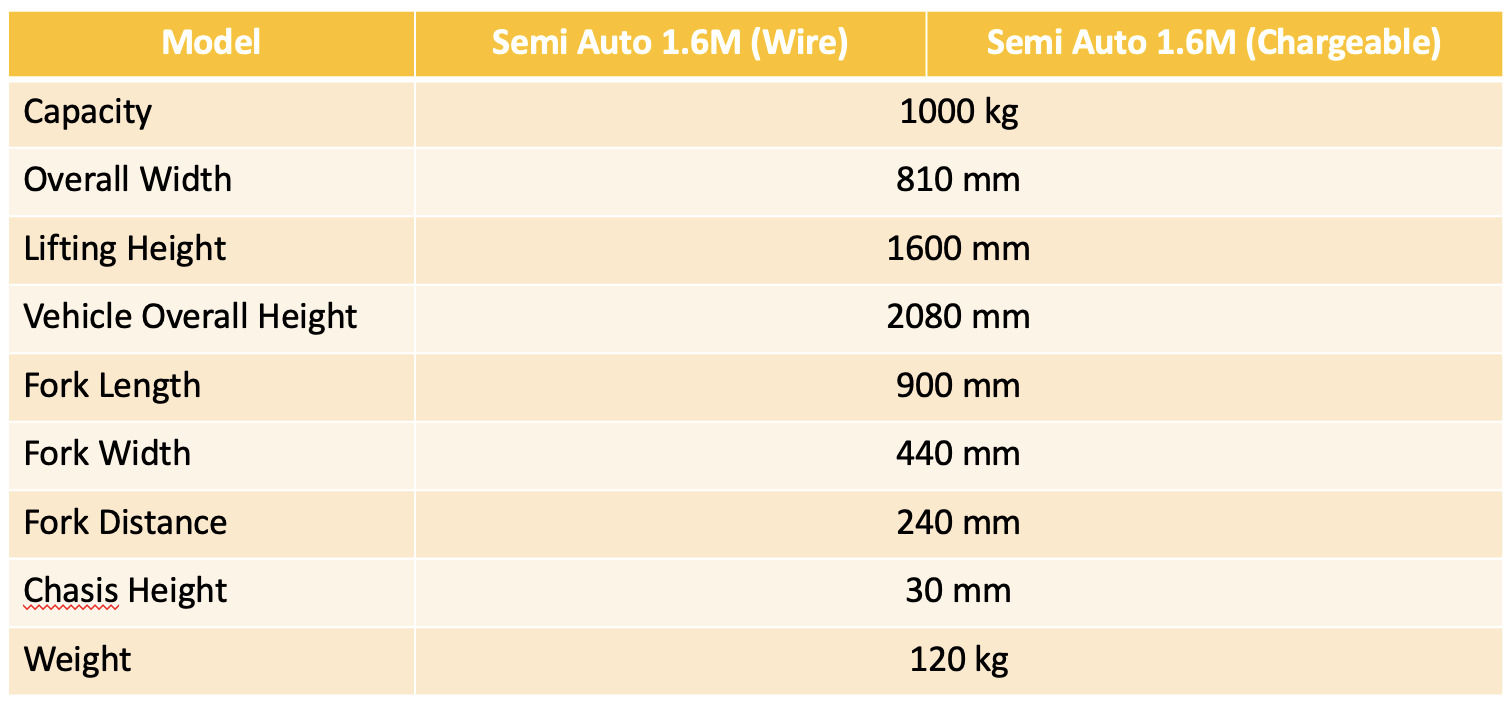
Confirm how the selected model lifts and travels. Use the model comparison on this page to check fork dimensions and lift height, then ask for the rated capacity at your required lift height and load centre.
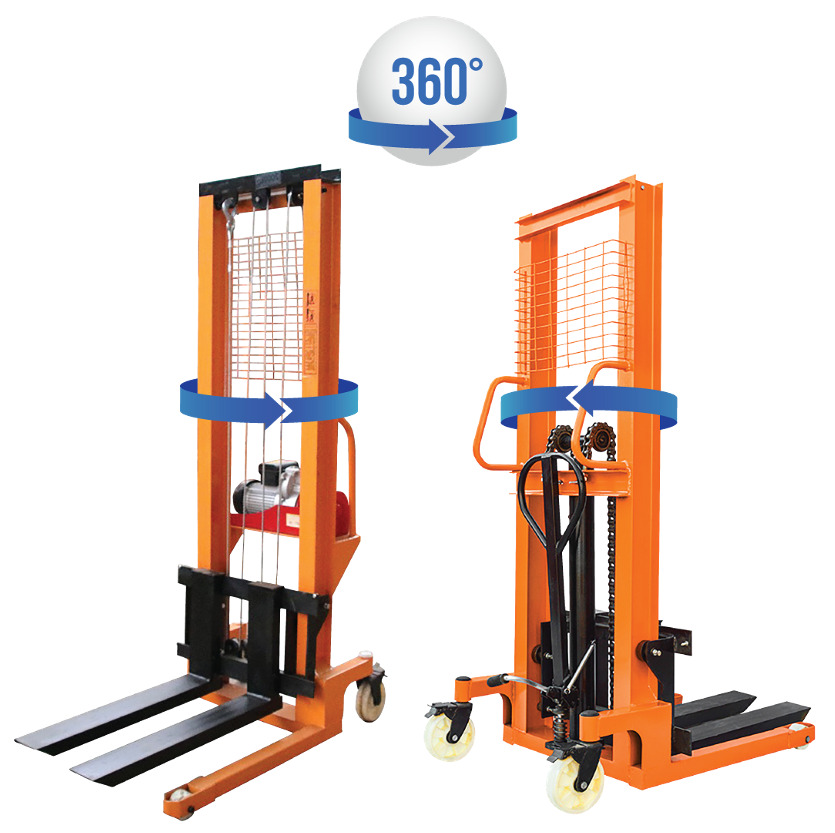
Stacker Turning Clearance
Confirm the quoted model’s turning radius and working aisle width for your pallet size and orientation. Check the tightest turns on your route, including any overhang from the load.
5 Easy Steps
1. Enquiry
Provide the pallet and load dimensions, total mass, required lifting height and your access aisle width, floor type and overhead clearance so we can identify suitable stacker models.
2. Model checks
Check the selected model's rated load at your required lift height, fork compatibility with your pallets and whether the power source and mast type suit your operating environment.
3. Model details
Confirm overall dimensions, lowered and raised mast heights, turning radius and weight against your aisle width, doorway clearance, floor loading and overhead obstructions.
4. Quotation
Review the quoted model, configuration, quantity, delivery scope and timing. Confirm applicable terms and any unloading, assembly, training or battery requirements before you accept.
5. Handover
Confirm the operating instructions, pre-use checks, training, warranty and support included for the selected stacker. Check delivery against the accepted quotation and agree any assembly or training arrangements before use.
Ready to make a change?
Choose Others under Enquiry on and include the equipment name in the Message field. For a stacker enquiry, share these details:
- Loaded pallet dimensions, maximum mass, entry and base construction
- Required lift height and available mast, doorway and rack clearance
- Operating aisle and turning space, floor conditions and route drawings
- Handling frequency, travel distances and required manual or powered functions
- Selected model, current load chart, training, warranty, service and availability requirements
Contact Hyperack to confirm the selected equipment and quotation scope.
FAQ
What industries benefit the most from using Stackers?
Consider a stacker for pallet-handling tasks in warehousing, manufacturing, retail backrooms or distribution where the selected model matches the load and route. Confirm lift height, pallet entry and support-leg clearance, floor conditions, operating space and handling frequency. The industry name or size of the building alone does not establish suitability.
Why should I use a Stacker instead of a forklift?
Compare the actual loads, lift heights, travel distances, handling frequency, available aisles and whole operating cost. A stacker may suit a particular pallet-positioning task, while another lift-truck arrangement may suit different duties. Compare the selected models and required operator training rather than assuming every stacker is cheaper, easier to operate or a replacement for a forklift.
How do Stackers help improve warehouse efficiency?
A suitable stacker can move the lifting task from manual handling to equipment and help place pallets at storage height. Evaluate the complete cycle: approaching the pallet, manoeuvring, lifting, placing and returning. Manual or powered travel, lift controls, operating space and handling frequency affect the result; confirm performance for the proposed task rather than promising a universal productivity gain.
Are Stackers suitable for narrow aisles or small warehouses?
Check the selected model’s operating and turning-space requirements with the actual loaded pallet. Include support legs, the operator’s working area, rack and doorway clearances and the route through the building. A compact machine dimension alone does not prove that a complete pallet-handling cycle fits your aisle. Ask for the relevant dimensions and a site-specific assessment before choosing the model.
How do Stackers help reduce workplace injuries?
Using suitable equipment can reduce the need to lift a pallet load manually. Review the whole task, including operator and pedestrian routes, load stability, pre-use checks and controlled handling. Match the machine to the work and provide appropriate training and supervision. A stacker purchase alone does not establish a reduction in workplace injuries.
What should I consider when choosing a Stacker?
- Maximum loaded pallet mass, dimensions and load centre; capacity at the required lift height
- Required fork height and available mast, doorway and overhead clearance
- Pallet entry, fork length and spacing, support-leg clearance and any approved attachments
- Handling frequency, travel distances, manual or powered functions and confirmed battery or charger details
- Operating and turning space, floor conditions, operator training, service scope and current availability
How durable are Stackers compared to forklifts?
Durability and maintenance depend on the actual model, duty cycle, operating conditions, care and available service support. Compare the manufacturer’s inspection and maintenance instructions, warranty scope, spare-parts availability and expected downtime for the models under consideration. A steel frame or hydraulic lift does not establish that every stacker lasts longer or needs less maintenance than a forklift.
Can Stackers handle non-standard pallets or custom-sized goods?
Confirm the pallet footprint, entry openings, base boards, fork length and spacing, support-leg clearance, loaded dimensions and load centre. The published SPE1016 and SPE1030 fork dimensions differ. An adjustable dimension or proposed attachment does not by itself confirm compatibility or capacity; ask for the manufacturer-approved arrangement and relevant load documentation for the exact unit.
Do Stackers require special training or certification to operate?
Confirm the training, demonstrated competence, supervision and employer authorisation appropriate to the selected model and task before use. Manual, semi-electric or electric labels alone do not establish the training needed. Ask a qualified local provider or responsible workplace adviser to confirm any current Malaysian certification or other requirements for the equipment and operation. Follow the unit’s operating instructions; this page is not an operator-training course.