

Warehouse racking
Drive-In Pallet Racking System
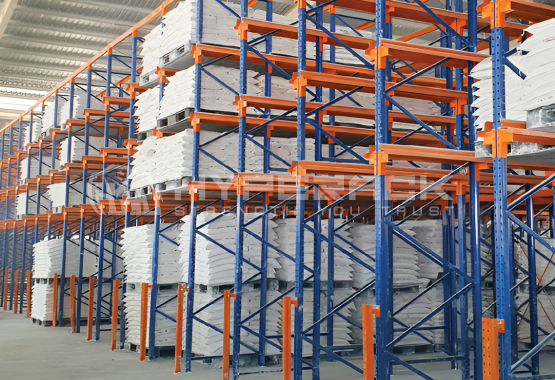
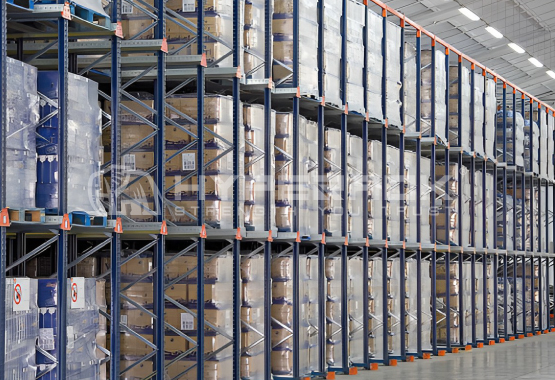
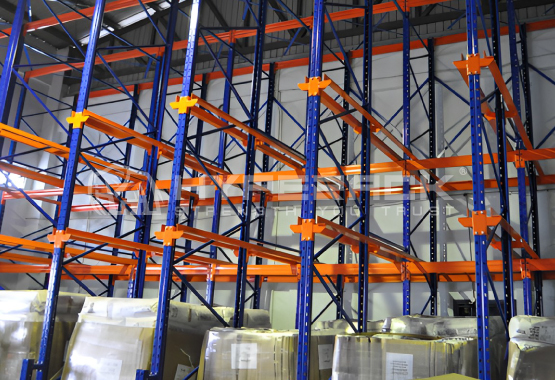
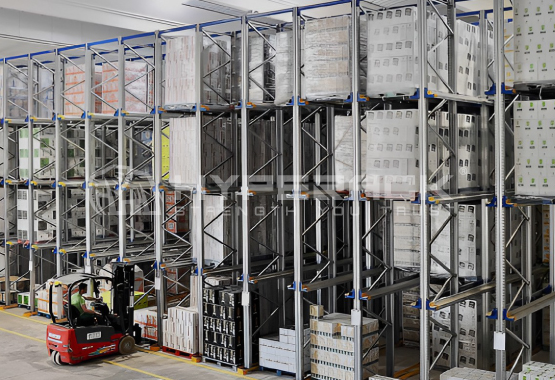
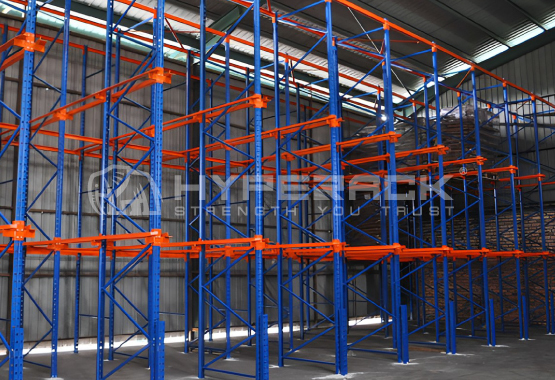
Hyperack supplies drive-in pallet racking in Malaysia. A forklift enters and leaves the same end of each lane, where pallets rest on support rails. Deep lanes suit groups of similar pallets when the planned retrieval order works from that end.
Hyperack’s published drive-in racking project for MOH Pharmaceutical Technologies in Shah Alam describes one such installation (view the project record).
Check your dispatch sequence before comparing quotes. If an older batch sits behind a newer one, the pallets nearer the aisle have to come out first. Ask Hyperack to mark the required dispatch order on the proposed layout and show which pallets can be reached directly.
If you need first-in, first-out retrieval, ask the designer to compare drive-through or another layout. Compare the number of pallet positions you can actually use under your dispatch rules.

Ideal for :
- High-Density Storage
- Large Quantities of the Same SKU
- Cold Storage & Freezer Warehouses
- LIFO Inventory Management
Layout and cost checks
- Deep lanes can save aisle space
- Compare installed cost per position
- Confirm maintenance access
- Group pallets by SKU or batch
Drive-In Pallet Racking Price in Malaysia
Compare installed quotes for the same number of usable pallet positions. Ask each supplier to separate the racks, delivery, installation, site work and any handling equipment changes. The warehouse racking cost guide has a worked example.
Send your layout, loaded pallet dimensions and maximum weight, pallets per SKU, rotation needs and forklift model. Ask the supplier to confirm lane-entry clearances for the proposed rack and truck.
5 Easy Steps
1. Send Details
Provide your pallet sizes, SKU batch counts, required lane depths, loading sequence and the forklift type used on site.
2. Review Scope
Discuss how lanes will be loaded and retrieved, the clearance your forklift needs inside the lane and entry access points.
3. Check Fit
Confirm that the proposed lane depth, rail spacing and entry clearance work with your forklift and batch rotation.
4. Compare Quotes
Check the quoted rack components, included upright protectors and installation scope against what was agreed in the layout review.
5. Plan Handover
Agree the installation sequence and confirm which protection, condition checks and load documents are included in the handover.
Ready to make a change?
Choose Pallet Racking under Enquiry on and select your project location. In Message, include Drive-In Pallet Racking, your loaded pallet size and weight, pallets per SKU and forklift model if known.

FAQ
Is Drive-In Racking suitable for small warehouses?
Drive-In Racking is typically ideal for large warehouses, but it can also be effective in smaller spaces if you prioritize storage density. By reducing the need for aisles, this system allows you to use vertical space, making it a great option even for warehouses with limited floor area. However, careful planning is essential to ensure it meets your storage needs and operational flow.
How much weight can Drive-In Racking hold?
The permitted load is specific to the installed drive-in design. Confirm the maximum loaded-pallet weight, including the pallet itself, and the limits for the specified rails, levels and complete structure. Give Hyperack your pallet type, dimensions, load distribution and heaviest loaded-pallet weight so these can be checked against the proposed configuration. Use the approved load information for that installation; a general capacity figure does not establish its rating.
What are the safety considerations for Drive-In Racking Systems?
Safety is a crucial consideration when implementing Drive-In Racking. It’s essential to ensure that forklifts are properly trained to navigate narrow lanes and load/unload pallets. Additionally, regular inspections of the racking system should be conducted to prevent accidents due to structural damage. Implementing safety barriers or guides can help protect workers and equipment from collisions.
How does Drive-In Racking impact inventory management?
While Drive-In Racking excels in storage efficiency, it may present challenges for inventory rotation. The system primarily follows the Last-In-First-Out (LIFO) method, which works well for items with a long shelf life or bulk storage. However, for products with expiration dates or seasonal items, Drive-In Racking may not be the best option. For optimal inventory management, integrating RFID or barcode scanning can help track stock more accurately.
How deep is the storage in a Drive-In Racking System?
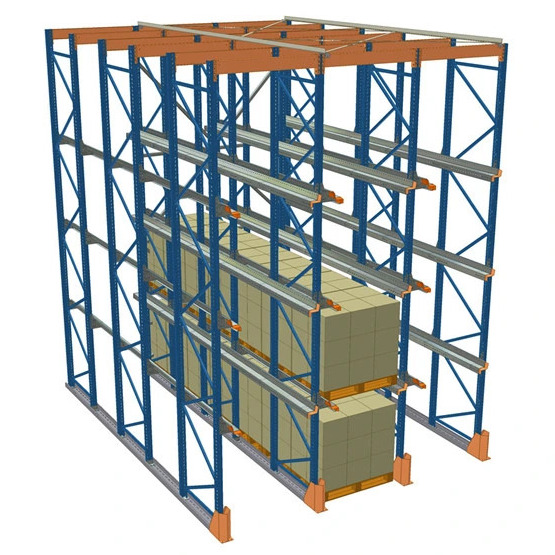
Lane depth is designed around your pallets, stock quantities, access and warehouse layout. Hyperack’s catalogue drawing shows one four-pallet-deep example; it is not a minimum, maximum or standard depth for every installation. Share pallets per SKU or batch, loaded-pallet dimensions, rotation requirements and forklift details. Confirm the proposed pallets per lane and overall footprint on the layout before ordering.
Are there any specific floor or foundation requirements for installing a Drive-In Racking system?
Yes, Drive-In Racking systems require a smooth, level, and durable concrete floor that can support the weight of both the racks and the stored goods. The foundation should be free from cracks or any structural weaknesses that could affect the stability of the racking system. It’s important that the floor be capable of handling the load capacity specified by the manufacturer to ensure safe operation.
What types of maintenance tools or equipment are required for Drive-In Racking systems?
Use the inspection checklist, records and any measuring tools specified for the installed system. Repairs, bolt tightening, component replacement and changes to rail or level positions should follow the supplier’s instructions and be handled by people competent for that work. Ask Hyperack to confirm the inspection and maintenance scope for your installation. Report impacts, damage or loose components promptly and follow the site procedure for restricting access until assessed; do not use a general tool list as repair instructions.
What kind of safety training is required for using a Drive-In Racking System?
Operators should be trained on the safe operation of forklifts, particularly in confined spaces such as Drive-In Racking systems. Training should cover load handling, proper pallet placement, and how to avoid overloading racks. Additionally, safety training should include the use of personal protective equipment (PPE), understanding of weight limits, recognizing hazards, and emergency procedures. Workers should also be trained to inspect racking systems for damage and report any issues promptly.
What are the common challenges faced when using Drive-In Racking, and how can they be mitigated?
Common challenges include limited access to older stock, forklift impacts and incorrect loading. A single-ended drive-in lane normally works on a Last In, First Out (LIFO) basis: pallets at the front must be cleared before pallets further inside can be reached. Plan SKU and batch allocation and stock rotation around this access pattern; labelling or FIFO inventory software alone does not change the physical access. If strict FIFO is required, ask the designer to assess a suitable layout, such as a drive-through arrangement with loading and picking from opposite ends. Check pallet and truck compatibility, rated loads, operator training and the inspection and maintenance plan against the specified system and its instructions.
How does a forklift drive in without hitting any pallet?
Forklift drivers are trained to operate in narrow aisles and navigate the system carefully. To avoid hitting any pallets, the Drive-In Racking system is often designed with adequate clearance and precise aisle widths to allow the forklift to maneuver without damaging the stored goods. Forklifts may also be equipped with safety sensors or cameras to help operators avoid collisions. Additionally, a clear operating procedure for the forklift drivers, including slow driving speeds and awareness of the load, helps ensure that pallets remain undisturbed.