

Warehouse racking


Push-Back Pallet Racking System
Push-back pallet racking stores several pallets in a channel served from one working aisle. A forklift loads at the front, moving earlier pallets back on the specified cart or roller arrangement. As the front pallet is retrieved, the next pallet returns towards the picking face by gravity. This same-face access follows last-in, first-out (LIFO) rotation within the channel; pallet compatibility and the complete loading and retrieval procedure must match the proposed system.
Push-back racking can be considered when your stock groups suit LIFO access and channel allocation. Plan a single SKU in each channel, with different SKUs assigned to other channels. Record the number of pallets per SKU, actual channel occupancy, loaded pallet dimensions and mass, and peak movements before comparing usable positions against another layout. The working aisle, forklift manoeuvring space and service access remain part of that comparison.
If the first pallet loaded must leave first, compare gravity-flow pallet racking with separate loading and retrieval faces. The appropriate arrangement depends on your stock rotation, carrier fit, available space, truck compatibility and written supply scope.

Ideal for :
- Repeated pallet loads with a planned single-SKU allocation for each storage channel.
- Stock groups whose replenishment, batch and date procedures suit LIFO access.
- Layouts with a planned shared loading and retrieval face, forklift aisle and access clearances.
- Ambient or cold-store operations where the specified components are confirmed for the actual environment.
Advantages :
- Several pallet positions grouped in a channel without routine forklift entry into the storage lane.
- Independent channels can accommodate different SKUs, with a single SKU normally assigned to each channel.
- Gravity brings the next pallet towards the working face using the return and retention controls specified for that design.
- Assess usable positions, aisle area, truck travel and complete handling cycles against the same inputs for alternative layouts.
Push-Back Pallet Racking Price in Malaysia
As a general guide, Push-Back pallet racking in Malaysia may cost around RM500 to RM800 per pallet location. The final price depends on the system configuration, load capacity, number of levels and project requirements.
For an accurate quotation, please share your warehouse layout and storage requirements with our team.
5 Easy Steps
1. Enquiry
Your journey begins with a simple enquiry. Once we receive your request, our team will review the details and match you with the right expert. We’ll then arrange a quick call or email to learn more about your goals and expectations.
2. Free Consultation
After your initial consultation, we’ll arrange a site visit to assess your space and needs in detail. You’ll meet your dedicated project manager, who will guide the process from start to finish—ensuring everything runs smoothly and efficiently.
3. 3D CAD Design
After the site survey, your project manager will recommend layout options tailored to your space and needs. We’ll then create accurate 3D CAD designs to help you visualise exactly how your facility will look once complete.
4. Instant Quote
You’ll receive a free, personalised quote with a full breakdown of the recommended equipment. We offer high-quality products at competitive prices, with reliable delivery times to keep your project on schedule.
5. Installation
We’ll agree on an installation schedule that suits your operations. Our accredited team will complete the setup, conduct a final inspection with you, and provide follow-up support, including annual safety checks.
Ready to make a change?
For a push-back pallet racking quotation, share these project details:
- Loaded pallet dimensions, mass, base construction and condition
- SKU count, storage positions, channel occupancy and rotation or date rules
- Peak loading and retrieval movements, operating hours and forklift details
- Usable height, columns, access, temperature and available floor drawings or load information
- Required supply, installation, testing, operator training and service scope
Contact Hyperack to discuss the proposed arrangement.

FAQ
What types of warehouses benefit most from Push Back Racking Systems?
Consider push-back racking where repeated pallet loads can be grouped into channels and the stock rotation permits LIFO access. Compare pallets per SKU, expected channel occupancy, peak movements and available forklift aisles. A warehouse or industry label alone does not establish suitability, capacity or handling performance; those depend on the proposed loads, layout and operating method.
How does Push Back Racking compare to Pallet Flow Racking?
Push-back racking loads and retrieves pallets from the same working face, so each channel operates LIFO. Opposite-ended pallet flow loads from one face and retrieves from the other, supporting FIFO through the channel. Compare the required rotation, pallet fit, usable layout and complete cost scope. Batch and expiry-date controls still need an operating process; neither arrangement is automatically faster or better for every warehouse.
Can Push Back Racking handle mixed SKUs within the same lane?
A push-back channel is normally allocated to a single SKU; other channels can hold different SKUs. Mixing SKUs in one channel can leave a required pallet behind other stock because access remains from the front. Adjustable rollers or stops do not create independent access to every pallet. If a mixed-SKU sequence is proposed, have the supplier verify its retrieval order and design suitability for the operation.
What safety features should be considered for Push Back Racking Systems?
Confirm which features are included in the proposed design and how they work with your pallets, loads and forklift procedure:
- Specified pallet retention or stops and carrier support suited to the actual pallet geometry and load condition.
- Return-control provisions for the selected cart or roller arrangement, confirmed against the intended load range.
- Appropriate rack impact protection, forklift working clearances and controlled access to storage and service areas.
Agree the operating instructions, load notices, training, inspection plan and responsible parties. A feature list alone does not establish safe operation, and the installed arrangement should be checked against its approved design.
What maintenance is required for Push Back Racking Systems?
Use the instructions for the configured equipment and an agreed inspection and maintenance plan. Relevant checks for trained, authorised personnel include:
- Cart or roller condition and any damaged or obstructed movement components, assessed under the equipment instructions.
- Rail, retention and return-control condition, with cleaning or servicing only as prescribed for the selected system.
- Rack structure and recorded impact damage, assessed alongside the site rack inspection plan.
- Pallet dimensions, base condition and load stability against the carrier requirements for that channel.
Agree service access and isolation procedures, qualified support, spare parts and maintenance records. Do not treat general website guidance as instructions to lubricate rails, adjust the mechanism or carry out repairs.
How much does Push Back Racking cost?
A quotation depends on the proposed storage positions, channel arrangement, loaded pallets, forklift compatibility and site conditions. Compare the written cost of racking and movement components, design, delivery, installation, protection, testing and any inspection or service items. Use equivalent inclusions and operating assumptions when comparing alternatives; there is no single price or guaranteed payback for every push-back installation.
What is the specification of Push Back Racking?
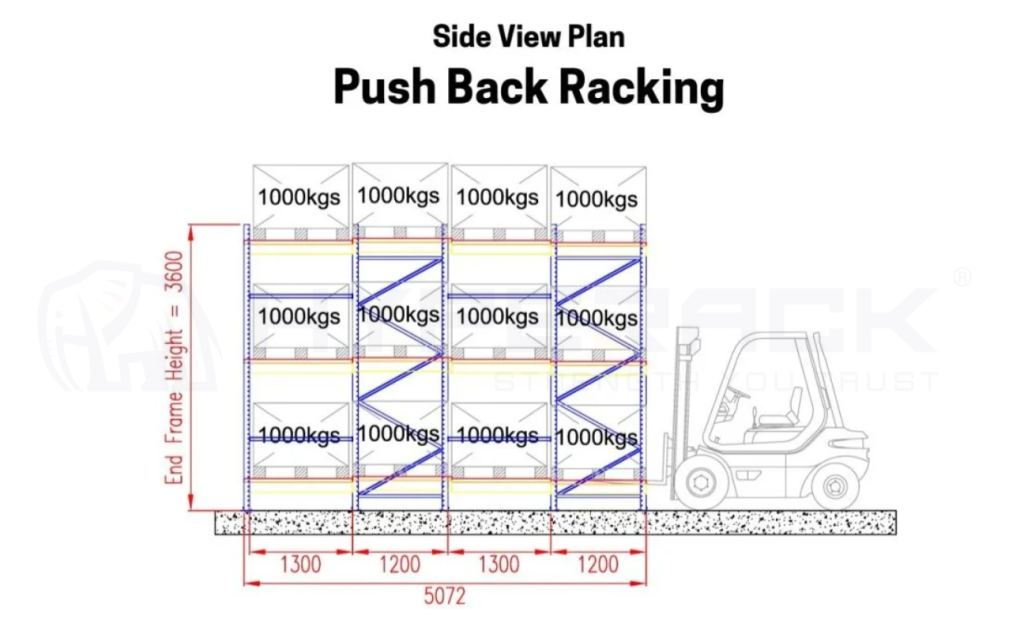
Hyperack’s published catalogue illustration shows a four-pallet-deep arrangement with three loaded levels and 1,000 kg labels on the drawn loads. This is an illustration, not a universal working-load rating, site approval or current-stock specification. Your proposal should state the loaded pallet dimensions and mass, channel depth, levels, forklift compatibility, layout limits and included movement or retention components.
Do Push Back Racking Systems require special forklifts?
Forklift compatibility must be checked for the actual arrangement. Confirm the loaded pallet, lift height, load centre, mast and any pushing-force requirements, together with manoeuvring space and the specified operating procedure. A counterbalance or reach-truck label alone does not establish compatibility. Ask which truck and configuration were used for the proposed design assessment and any agreed acceptance test.
How deep can Push Back Racking Systems be configured?
Channel depth depends on the selected cart or roller system, loaded pallet geometry and mass, forklift requirements, available space and stock allocation. Ask for the proposed number of positions per channel and how that arrangement will be verified with representative loads. A catalogue example or another manufacturer’s range should not be treated as the permitted depth for every Hyperack installation.
Can Push Back Racking Systems be used in cold storage or freezer environments?
Push-back storage can be evaluated for a cold store when the specified materials, moving components and servicing requirements suit the actual temperature, condensation conditions and duty. Confirm the equipment limits and representative-load testing with the supplier. A coating or finish alone does not establish freezer suitability, product temperature control or a measured energy saving for the proposed installation.