

Warehouse racking
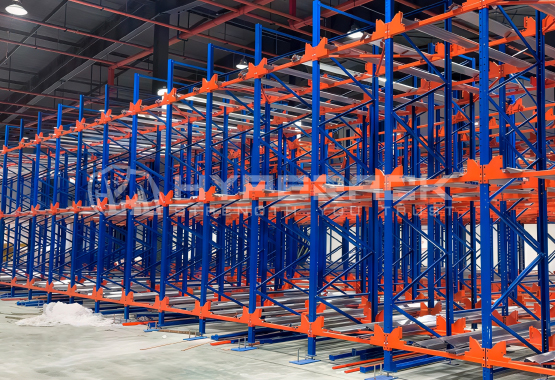
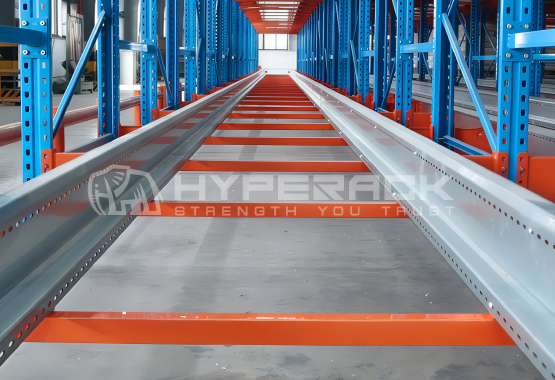
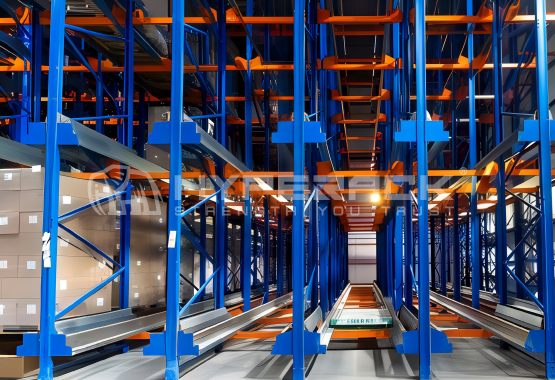
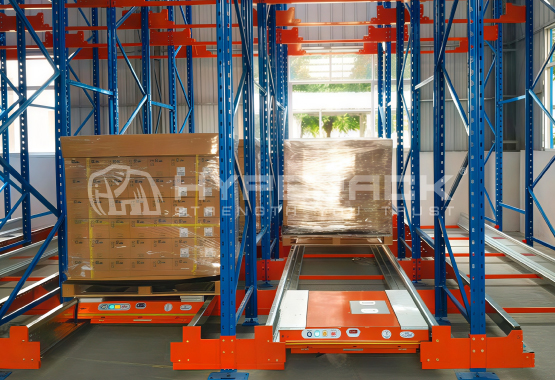
Two-Way Shuttle Pallet Racking System
A two-way shuttle racking system uses a battery-powered, remote-controlled shuttle that travels forward and back along rails within deep racking lanes, positioning pallets on specified lane supports. The forklift presents and collects pallets at the selected lane end and positions or transfers the shuttle between lanes and levels as the layout requires. Single-ended lanes operate as LIFO; an opposite-ended arrangement can support FIFO where specified in the design.
Hyperack supplies two-way shuttle racking with different profiles to suit project requirements. For a detailed comparison of operation and stock rotation options, see our guide to shuttle racking. To assess whether a shuttle system suits your operation, start with your actual pallet dimensions, loaded mass, SKU and position count, peak inbound and outbound flow, and available site drawings.
Ideal for
- Repeated pallet loads where carrier dimensions, loaded mass and SKU position requirements have been recorded for design verification.
- Deep-lane storage layouts where actual lane occupancy, SKU allocation and stock rotation method are assessed before commitment.
- Cold or controlled environments where equipment, battery and charging specifications are confirmed for the actual operating temperature and duty cycle.
- Operations with documented simultaneous peak inbound and outbound volumes, including forklift handover frequency and shuttle count.
- Projects comparing forklift-served shuttle automation against other storage options using measured layout, cost and ongoing service assumptions.
Advantages
- Powered pallet movement along the selected lane, with normal forklift access at the lane face; confirm complete storage and retrieval cycle performance.
- Defined division of forklift, operator and shuttle tasks in each workflow; verify staffing requirements and error-handling procedures for the proposed configuration.
- Usable pallet positions assessed with actual lane depth, SKU allocation, growth allowance and machinery clearance constraints.
- Routine forklift operation at lane faces with specified safeguards, trained operator procedures and authorised service access still required.
- Layout retains actual forklift aisles, shuttle transfer space, charging stations and service clearances; compare net usable area against the same inputs for alternative systems.
2-Way Shuttle Racking Price in Malaysia
Compare installed quotes for the same number of usable pallet positions. Ask each supplier to separate the racks, shuttle carriers, charging equipment, commissioning, training and ongoing support. The warehouse racking cost guide has a worked example.
Send your loaded pallet dimensions and maximum weight, pallets per SKU, peak movements and forklift model. Confirm how the forklift transfers pallets to the shuttle and where the shuttle is charged.
5 Easy Steps
1. Send Details
Share your pallet sizes, SKU count, required lane depths and how batches rotate between the receiving and dispatch faces.
2. Review Scope
Discuss which lanes suit shuttle operation, how the forklift interface works at the lane face and charging needs.
3. Check Fit
Confirm that the proposed lane depths, shuttle dimensions and forklift interface suit your floor plan and batch rotation.
4. Compare Quotes
Check the quoted racking, shuttle units, charging stations and delivery against the layout agreed in the scope review.
5. Plan Handover
Agree on handover checks for shuttles, charging points, racking and any interface items with your existing forklift operation.
Ready to make a change?
For a two-way shuttle racking quotation, share these project details:
- Pallet dimensions, loaded mass and load stability or condition
- SKU count, storage positions, lane allocation and rotation rules
- Simultaneous peak inbound and outbound movements, operating hours and forklift handovers
- Available floor drawings or load information, usable height, columns, aisles, temperature, charging and service space
- Equipment and software interfaces, with supply, testing, training and service responsibilities
Contact Hyperack to discuss your proposed configuration. Email floor drawings or load documents to order@hyperack.com.my.

FAQ
What makes Shuttle Racking Systems more efficient than traditional racking?
In this forklift-served arrangement, the shuttle moves pallets within a lane while the forklift works at its face during normal storage and retrieval. Assess the complete workflow rather than one machine movement: compare usable pallet positions, SKU occupancy, simultaneous peak inbound and outbound flow, staffing and total equipment and service costs with your current or alternative layout.
How does the Shuttle in a Racking System operate?
The shuttle is battery-powered and travels along rails installed within each racking lane. An operator uses a remote controller to command the shuttle to store or retrieve pallets at specified positions along the lane supports. The forklift presents and collects pallets at the selected lane end and positions or transfers the shuttle between lanes and levels as the layout requires. Controller and software interfaces vary by equipment model and project specification.
Is a Shuttle Racking System cost-effective for smaller warehouses?
Cost-effectiveness depends on your actual storage volume, lane occupancy, peak throughput requirement and the combined cost of racking, shuttle hardware, charging, integration, site preparation and ongoing service. Compare the total lifecycle cost and usable positions of a shuttle system against selective racking or other alternatives using the same volume, labour and equipment assumptions for your specific operation.
How does Shuttle Racking benefit cold storage operations?
Shuttle racking can be evaluated for cold or controlled-temperature environments when the shuttle, controller, sensors, battery type and charging arrangement are specified for the actual operating temperature, duty cycle and condensation conditions at your site. Confirm the equipment manufacturer’s quoted temperature range, battery performance and any required modifications before committing to a cold-store configuration.
Can a Shuttle Racking System be integrated with existing warehouse management systems (WMS)?
Integration can be assessed where the selected controller and interfaces support the required data exchange. Inventory and order-management functions are separate from shuttle commands. Confirm the available data, update and error handling, testing and support responsibilities, and whether a WMS connection is required and included for your proposed operation.
What are the key components of a Shuttle Racking System?
Confirm the proposed racking and lane rails, shuttle units, remote controller, batteries and charging equipment, and compatible forklift handovers. Inventory or other software interfaces may be included where specified. Use the quotation to identify who supplies, installs, integrates, tests and supports each part of the arrangement.
How does a Shuttle Racking System improve warehouse space utilization?
Deep lanes group several pallet positions behind a shared lane face. Compare the usable position count and occupied space on a layout reflecting your SKU allocation, stock rotation, pallet dimensions and site height. Include forklift aisles, transfer, charging and service areas in the calculation. Lane depth alone does not establish a capacity gain.
How does the Shuttle Machine navigate within the racking system?
Rails guide the shuttle within the selected lane. Model-specific sensors and controls manage position detection, stopping and commands. Confirm compatibility with the pallet geometry, load condition and specified lane tolerances, together with the operating, maintenance and recovery procedures for the proposed equipment.
What maintenance is required for a Shuttle Racking System?
Use the equipment manufacturer’s instructions alongside the rack inspection plan. Agree who carries out equipment servicing, battery and charging care, rack inspections and software updates, with the training and authorisation required for each task. Confirm spare-parts and service arrangements in the proposal.
How fast can a Shuttle Machine operate?
Ask for the selected model’s travel speed and handling cycle, then evaluate complete pallet movements per hour using your loaded pallet mass, lane depth, shuttle count, forklift handovers, queues and charging plan. Travel speed alone does not establish warehouse throughput. Confirm performance against simultaneous peak inbound and outbound demand and agreed acceptance tests.