

Products
Stacker
A stacker lifts and positions palletised loads using a mast and forks. Choose the equipment around the loaded pallet, required lift height, handling frequency and available operating space. Confirm whether travel and lifting are manual or powered on the actual model being quoted; those functions affect operator effort and the working method.
Hyperack’s published stacker catalogue page lists SPE1016 and SPE1030. The comparison below transcribes selected catalogue labels; it does not confirm current stock or the specification of a particular unit.
On a phone, swipe the model comparison sideways.
| Catalogue label | SPE1016 | SPE1030 |
|---|---|---|
| Published capacity label (kg) | 1000 | 1000 |
| Minimum fork height (mm) | 88 | 85 |
| Maximum fork height (mm) | 1600 | 3000 |
| Minimum mast height (mm) | 2078 | 2080 |
| Fork length (mm) | 1150 | 900 |
| Overall fork width (mm) | 800 | 300–640 |
Both catalogue models carry a 1000 kg capacity label, with different maximum fork heights and fork dimensions. That label does not establish 1000 kg capacity at every lift height, load centre or attachment configuration. Ask for the selected unit’s load chart and operating instructions, and confirm pallet entry, fork and support-leg clearance, mast clearance and manoeuvring space before ordering. The catalogue battery heading is ambiguous, so electrical and charger details also need model-specific confirmation.
Ideal for
- Pallet stacking where the selected model’s documented load and lift requirements match
- Material handling with confirmed pallet entry and fork or support-leg clearance
- Backroom or distribution tasks with adequate manoeuvring and operator space
- Routes checked for floor condition, doorway and overhead clearance
- Handling duties matched to the chosen travel, lifting and training arrangements
Advantages
- Positions compatible pallet loads at the documented lift height
- Offers model-specific fork and mast dimensions to compare with the site
- Can replace manual lifting within a suitable handling process
- Allows manual or powered functions to be specified for the required duty
- Supports equipment selection against load charts, operating instructions and service scope
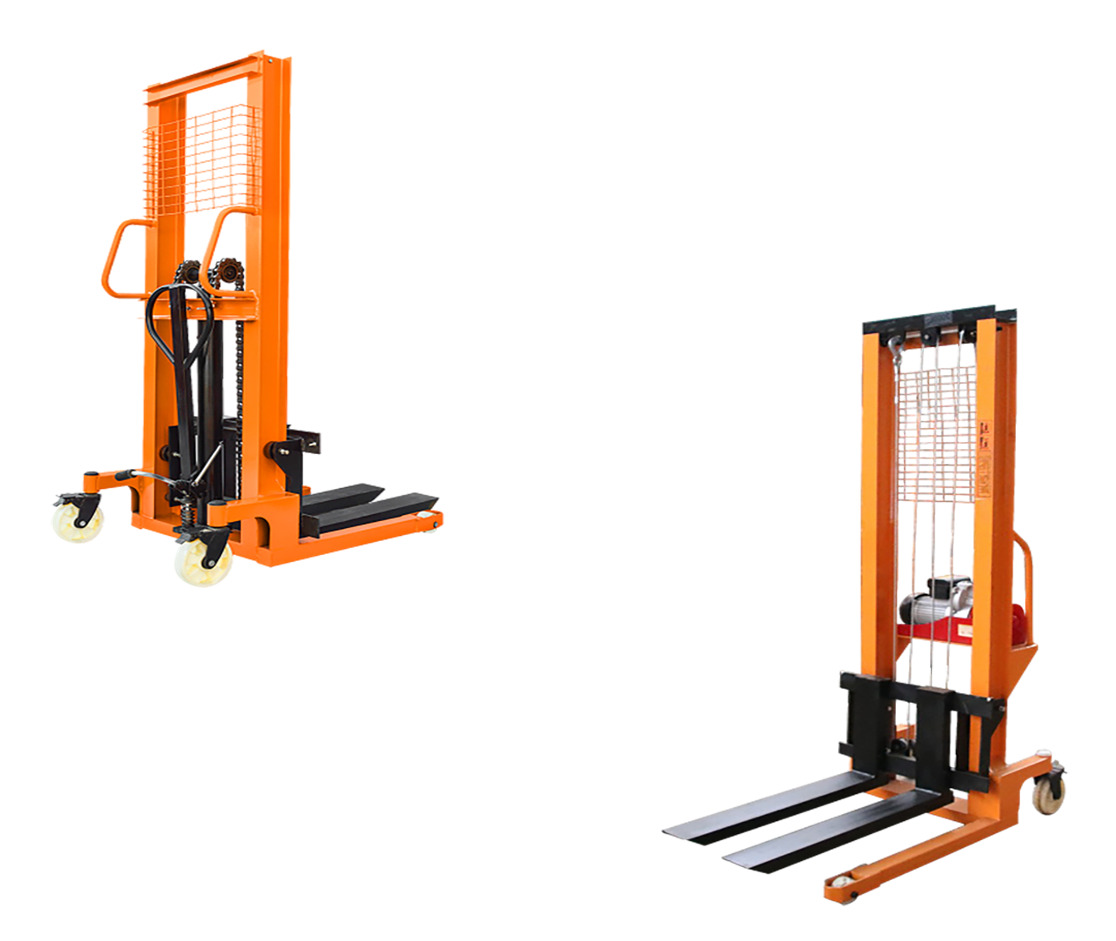
Manual / Semi-Electric Stacker
Stackers are designed to safely lift and move palletised goods to higher levels. Compact and easy to operate, they’re perfect for warehouses, stores, and tight workspaces.
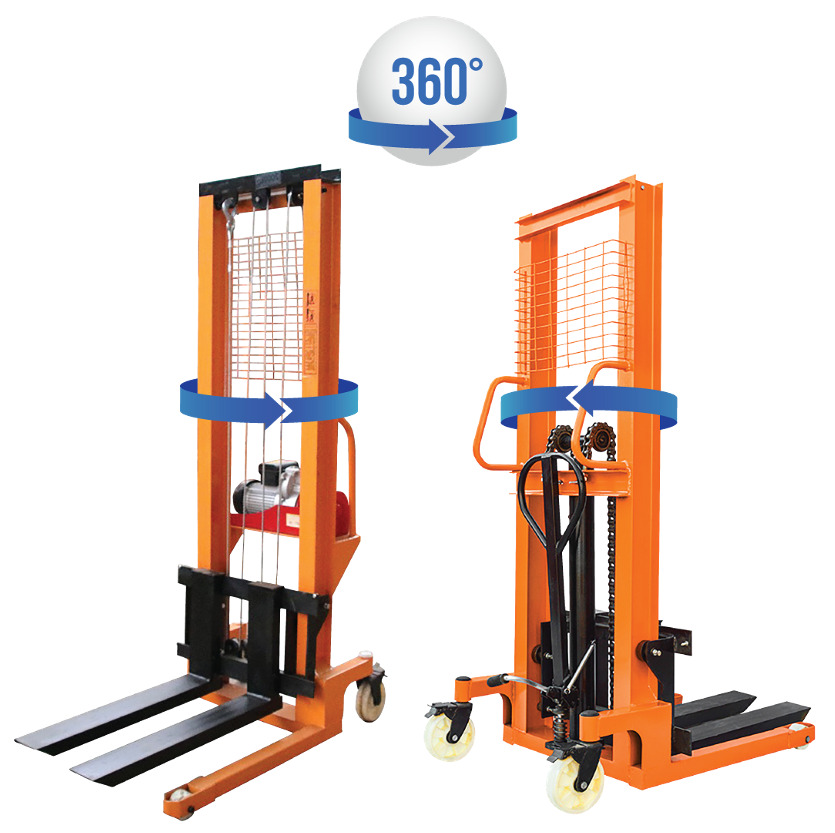
Rotating Stacker (360°)
Rotating Stacker is designed with a 360° turnable body, making it easier to lift, rotate, and place pallets with greater flexibility. Perfect for tight working spaces and tasks that require precise positioning.
5 Easy Steps
1. Enquiry
Your journey begins with a simple enquiry. Once we receive your request, our team will review the details and match you with the right expert. We’ll then arrange a quick call or email to learn more about your goals and expectations.
2. Free Consultation
After your initial consultation, we’ll arrange a site visit to assess your space and needs in detail. You’ll meet your dedicated project manager, who will guide the process from start to finish—ensuring everything runs smoothly and efficiently.
3. 3D CAD Design
After the site survey, your project manager will recommend layout options tailored to your space and needs. We’ll then create accurate 3D CAD designs to help you visualise exactly how your facility will look once complete.
4. Instant Quote
You’ll receive a free, personalised quote with a full breakdown of the recommended equipment. We offer high-quality products at competitive prices, with reliable delivery times to keep your project on schedule.
5. Installation
We’ll agree on an installation schedule that suits your operations. Our accredited team will complete the setup, conduct a final inspection with you, and provide follow-up support, including annual safety checks.
Ready to make a change?
For a stacker enquiry, share these details:
- Loaded pallet dimensions, maximum mass, entry and base construction
- Required lift height and available mast, doorway and rack clearance
- Operating aisle and turning space, floor conditions and route drawings
- Handling frequency, travel distances and required manual or powered functions
- Selected model, current load chart, training, warranty, service and availability requirements
Contact Hyperack to confirm the selected equipment and quotation scope.
FAQ
What industries benefit the most from using Stackers?
Consider a stacker for pallet-handling tasks in warehousing, manufacturing, retail backrooms or distribution where the selected model matches the load and route. Confirm lift height, pallet entry and support-leg clearance, floor conditions, operating space and handling frequency. The industry name or size of the building alone does not establish suitability.
Why should I use a Stacker instead of a forklift?
Compare the actual loads, lift heights, travel distances, handling frequency, available aisles and whole operating cost. A stacker may suit a particular pallet-positioning task, while another lift-truck arrangement may suit different duties. Compare the selected models and required operator training rather than assuming every stacker is cheaper, easier to operate or a replacement for a forklift.
How do Stackers help improve warehouse efficiency?
A suitable stacker can move the lifting task from manual handling to equipment and help place pallets at storage height. Evaluate the complete cycle: approaching the pallet, manoeuvring, lifting, placing and returning. Manual or powered travel, lift controls, operating space and handling frequency affect the result; confirm performance for the proposed task rather than promising a universal productivity gain.
Are Stackers suitable for narrow aisles or small warehouses?
Check the selected model’s operating and turning-space requirements with the actual loaded pallet. Include support legs, the operator’s working area, rack and doorway clearances and the route through the building. A compact machine dimension alone does not prove that a complete pallet-handling cycle fits your aisle. Ask for the relevant dimensions and a site-specific assessment before choosing the model.
How do Stackers help reduce workplace injuries?
Using suitable equipment can reduce the need to lift a pallet load manually. Review the whole task, including operator and pedestrian routes, load stability, pre-use checks and controlled handling. Match the machine to the work and provide appropriate training and supervision. A stacker purchase alone does not establish a reduction in workplace injuries.
What should I consider when choosing a Stacker?
- Maximum loaded pallet mass, dimensions and load centre; capacity at the required lift height
- Required fork height and available mast, doorway and overhead clearance
- Pallet entry, fork length and spacing, support-leg clearance and any approved attachments
- Handling frequency, travel distances, manual or powered functions and confirmed battery or charger details
- Operating and turning space, floor conditions, operator training, service scope and current availability
How durable are Stackers compared to forklifts?
Durability and maintenance depend on the actual model, duty cycle, operating conditions, care and available service support. Compare the manufacturer’s inspection and maintenance instructions, warranty scope, spare-parts availability and expected downtime for the models under consideration. A steel frame or hydraulic lift does not establish that every stacker lasts longer or needs less maintenance than a forklift.
Can Stackers handle non-standard pallets or custom-sized goods?
Confirm the pallet footprint, entry openings, base boards, fork length and spacing, support-leg clearance, loaded dimensions and load centre. The published SPE1016 and SPE1030 fork dimensions differ. An adjustable dimension or proposed attachment does not by itself confirm compatibility or capacity; ask for the manufacturer-approved arrangement and relevant load documentation for the exact unit.
Do Stackers require special training or certification to operate?
Confirm the training, demonstrated competence, supervision and employer authorisation appropriate to the selected model and task before use. Manual, semi-electric or electric labels alone do not establish the training needed. Ask a qualified local provider or responsible workplace adviser to confirm any current Malaysian certification or other requirements for the equipment and operation. Follow the unit’s operating instructions; this page is not an operator-training course.