

Warehouse racking
Gravity Flow Pallet Racking System
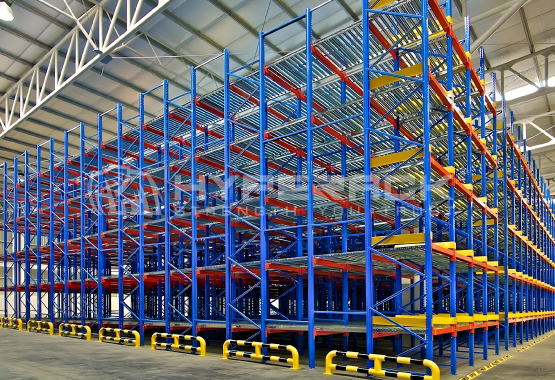
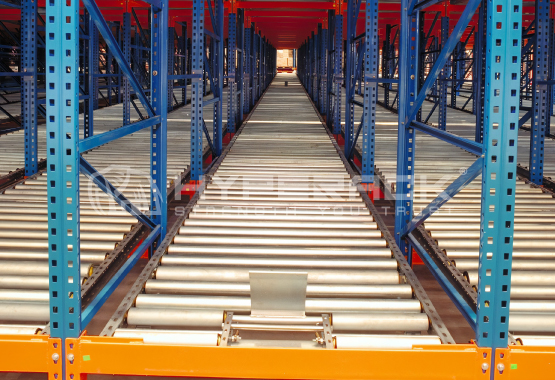
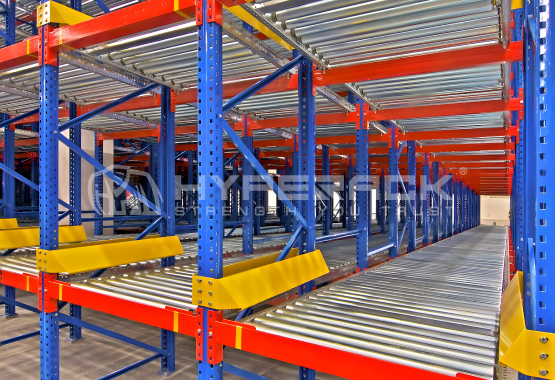
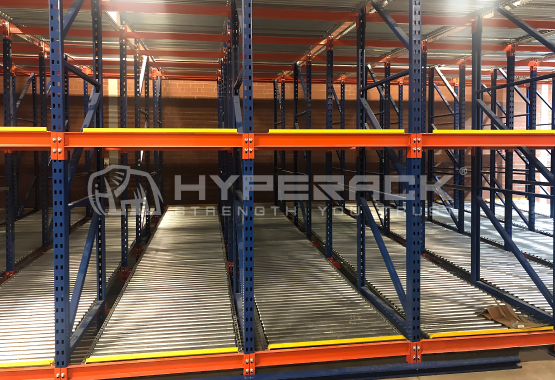
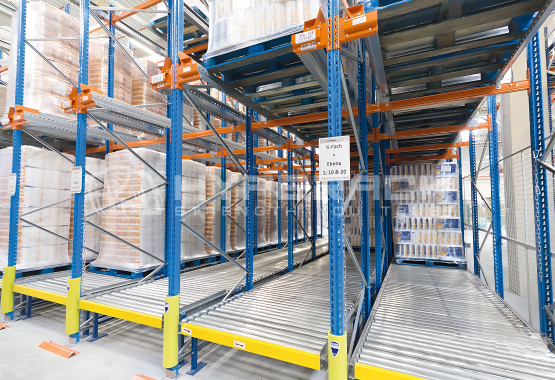
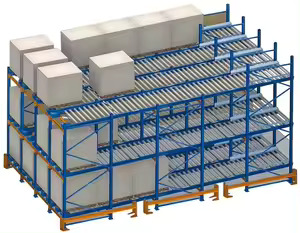
Gravity-flow pallet racking moves compatible palletised loads along inclined roller channels. In an opposite-ended arrangement, pallets enter at the loading face and move towards a separate retrieval face, supporting first-in, first-out (FIFO) access through each channel. The carrier, loaded mass, track and flow-control design must work together. Gravity supplies the movement; the proposed layout and operating process determine usable positions, stock allocation and complete handling performance.
Select a flow arrangement around the actual load carrier. Pallet flow and smaller carton or tote flow use support and roller arrangements matched to their carriers; they are not interchangeable simply because both use gravity. Provide the loaded base dimensions, mass, contact surfaces, condition and stability for a compatibility assessment, together with the intended SKU allocation and batch or date process.
Compare the complete site layout, including loading and retrieval aisles, manoeuvring space and service access. If both operations must use the same face and LIFO rotation is suitable, compare push-back pallet racking. Neither system establishes a fixed percentage of space savings or a handling rate without the actual layout and operating assumptions.
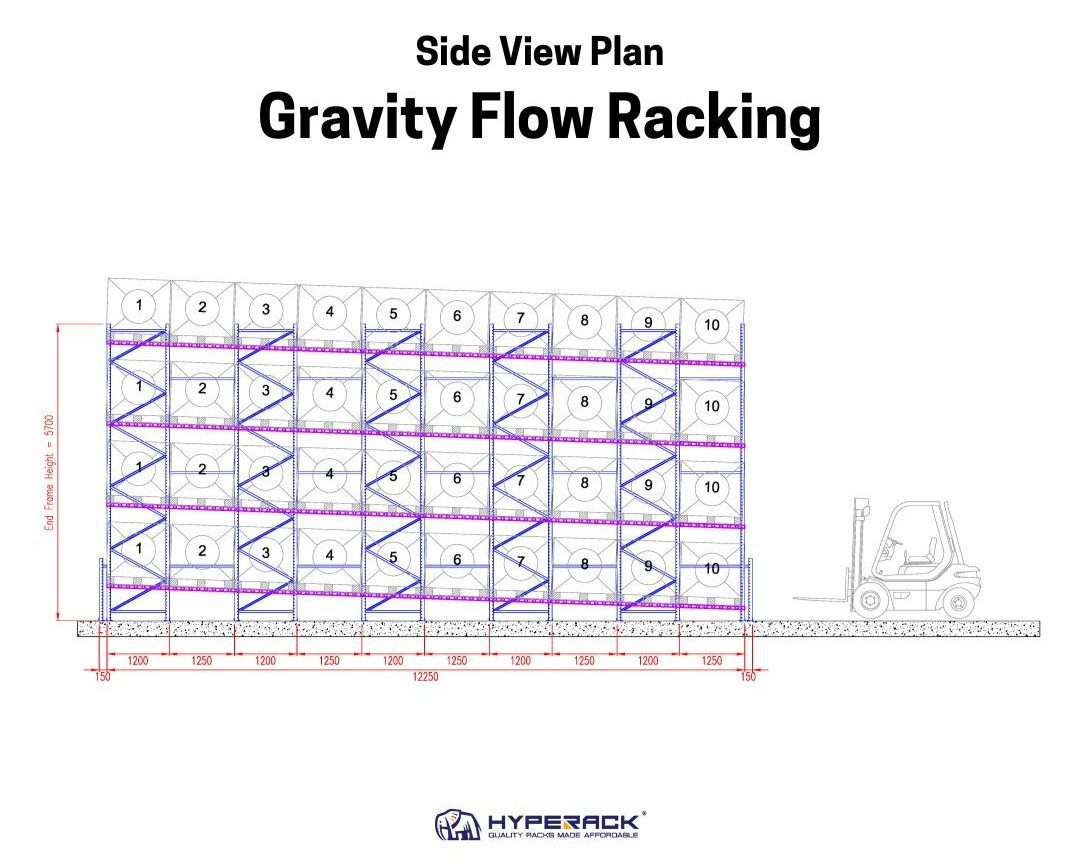
Ideal for
- Repeated compatible pallet loads that can be allocated to channels with FIFO access.
- Operations with defined SKU, replenishment, batch or date rules and recorded loading and retrieval flows.
- Sites where separate loading and retrieval faces, truck movement and all required access clearances can be planned.
Advantages
- Usable positions grouped into storage channels, assessed against actual occupancy, aisle area and site constraints.
- A physical FIFO route supported by disciplined channel allocation and the required batch or date process.
- Separate loading and retrieval faces included in a complete forklift, access and service plan.
- Gravity-fed movement within the selected channel, with specified flow controls and complete-cycle throughput assessed for the operation.
Gravity Flow Racking Price in Malaysia
As a general guide, Gravity Flow Racking in Malaysia may cost around RM1,000 to RM1,500 per pallet location. The final price depends on the system configuration, load capacity, pallet dimensions and project requirements.
For an accurate quotation, please share your warehouse layout and storage requirements with our team.
5 Easy Steps
1. Enquiry
Your journey begins with a simple enquiry. Once we receive your request, our team will review the details and match you with the right expert. We’ll then arrange a quick call or email to learn more about your goals and expectations.
2. Free Consultation
After your initial consultation, we’ll arrange a site visit to assess your space and needs in detail. You’ll meet your dedicated project manager, who will guide the process from start to finish—ensuring everything runs smoothly and efficiently.
3. 3D CAD Design
After the site survey, your project manager will recommend layout options tailored to your space and needs. We’ll then create accurate 3D CAD designs to help you visualise exactly how your facility will look once complete.
4. Instant Quote
You’ll receive a free, personalised quote with a full breakdown of the recommended equipment. We offer high-quality products at competitive prices, with reliable delivery times to keep your project on schedule.
5. Installation
We’ll agree on an installation schedule that suits your operations. Our accredited team will complete the setup, conduct a final inspection with you, and provide follow-up support, including annual safety checks.
Ready to make a change?
For a gravity-flow pallet racking quotation, share these project details:
- Loaded pallet dimensions, mass, base construction and condition
- SKU count, storage positions, channel occupancy and rotation or date rules
- Peak loading and retrieval movements, operating hours and forklift details
- Usable height, columns, access, temperature and available floor drawings or load information
- Required supply, installation, testing, operator training and service scope
Contact Hyperack to discuss the proposed arrangement.

FAQ
How does a Gravity Flow Racking System ensure the FIFO principle?
In an opposite-ended arrangement, pallets enter from the loading face and travel along roller channels towards the retrieval face. The first pallet loaded is available first at the other end. A channel is normally allocated to one SKU, with an operating process for batches and dates. This physical sequence supports FIFO; it does not by itself select the stock with the earliest expiry date.
What industries benefit the most from Gravity Flow Racking Systems?
Evaluate gravity flow where repeated pallet loads, channel allocation and a FIFO process suit the required movements. Food, drinks and other operations may use this arrangement, but the industry name alone does not establish suitability. Check the carrier, occupancy, peak flows and site layout, together with any temperature, hygiene and expiry-control requirements specific to the goods.
What are the safety features of a Gravity Flow Racking System?
Ask which flow-control and protection features are designed into the actual proposal, such as braking, separation, retention, guides or access safeguards where applicable. Their suitability must be verified for the intended carrier and load range. Do not assume every feature is standard or that a stop will catch any misaligned load. Operating instructions, training, load notices and inspection remain part of the arrangement.
Can Gravity Flow Racking Systems handle different types of products?
Different products can be assessed through a carrier-specific design. Pallet flow and smaller carton or tote flow need suitable tracks, support and contact surfaces for their respective loads. Confirm the intended minimum and maximum loaded mass, base dimensions, condition and stability for the selected configuration. A general product category or roller material does not establish a universal load rating or compatibility.
What maintenance does a Gravity Flow Racking System require?
Follow the instructions for the configured system and an agreed inspection and service plan. Trained, authorised personnel should assess the relevant track, retention and flow-control components, rack impact condition and pallet compatibility, with findings recorded. Agree safe service access and responsible parties. General website advice is not a procedure for tightening, realigning, lubricating or changing the slope of an installed lane.
How does the incline angle of a Gravity Flow Racking System affect product movement?
The specified incline works together with the carrier geometry and contact surface, loaded mass, friction and flow-control arrangement. The supplier should assess the design and verify movement using representative loads for the intended conditions. There is no single angle for every load or system, and users should not change the installed slope or controls to tune movement without the responsible supplier’s procedure.
What are the key design considerations for optimizing a Gravity Flow Racking System?
Provide loaded carrier dimensions, mass, base condition and stability; SKU counts, positions and channel occupancy; FIFO, batch and date rules; and peak loading and retrieval flows. Include usable height, columns, access, temperature and available floor information for design verification. The proposal should define the layout, selected movement and control components, acceptance checks, operating instructions and service responsibilities.
How do roller and wheel materials in Gravity Flow Racking Systems impact load capacity and performance?
Material selection is one part of the design. Roller and track assembly, support, spacing, environment, carrier contact surface and loaded mass also affect suitability. Ask for the intended operating limits and how the complete arrangement will be verified with representative loads. Steel, plastic or another material name alone does not certify a working-load rating, noise level, durability or compatibility with the product.
Can a Gravity Flow Racking System be customized to fit specific warehouse dimensions?
A layout can be assessed against the available height and depth, columns, loading and retrieval access, required escape or fire provisions and floor information for responsible design verification. Load characteristics, FIFO allocation and service access also affect feasibility. Ask for the proposed layout and confirmed scope; a general statement about customisation does not establish that every warehouse can accommodate the same arrangement.
How does a Gravity Flow Racking System handle temperature-sensitive products during storage and retrieval?
Gravity-flow racking is storage and handling equipment, not refrigeration. Confirm that the specified materials, rollers and other components are suitable for the actual temperature, condensation conditions and loads, with appropriate testing. Product cold-chain, hygiene and date controls remain operating requirements. Insulated rollers or changing lane speed or incline should not be assumed to keep goods within their required temperature limits.