

What is a Push Back Racking System?
- 20/12/2024
- Posted by: macgad-admin
- Category: Racking System
What is a Push Back Racking System?
For many Malaysian warehouses looking to save space and streamline inventory access, push back racking offers an efficient solution. This storage system uses inclined rails and wheeled carts or rollers to store multiple pallets deep in a single lane, with each lane normally allocated to one SKU. Pallets are loaded and retrieved from one working face, making push back racking a Last-In, First-Out (LIFO) system. In this article, we explore how it works, what to consider when choosing it, and how to plan for installation.
How Does a Push Back Racking System Work?
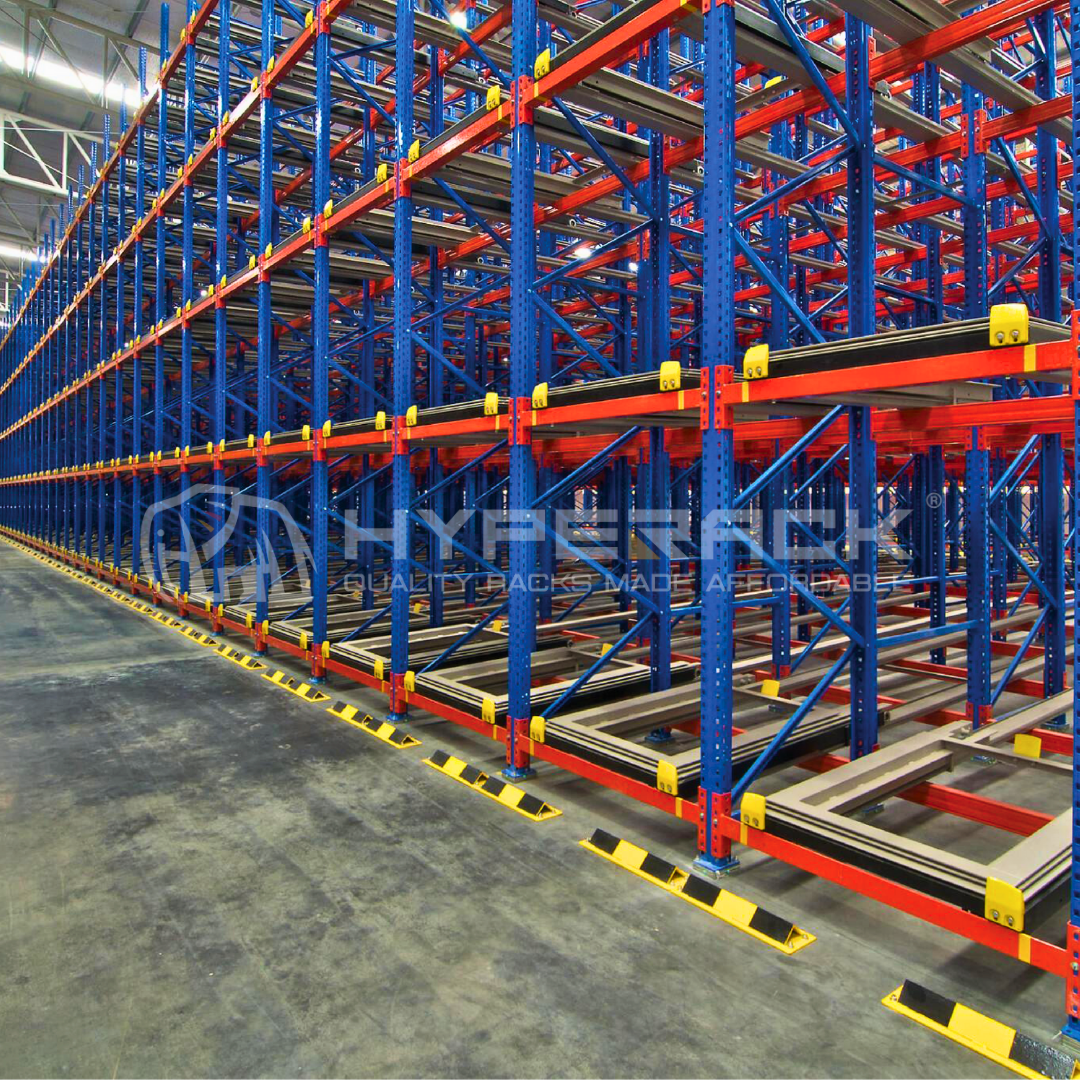
Push back racking uses inclined rails fitted with nested carts or rollers inside each lane. When a new pallet is loaded at the front, it pushes the existing pallets back along the rails. The specified cart or roller arrangement, stops and retention controls govern loading and retrieval.
For instance, in a three-deep configuration, loading the first pallet places it at the front of the lane. Adding a second pallet pushes the first one back to the second position, and so on. When the front pallet is retrieved, the next pallet rolls forward under controlled gravity along the inclined rails. Return movement and stopping must follow the system’s specified controls and operator procedure. Confirm truck capacity, reach, load handling and aisle clearances against the proposed system and its operating procedure.


Benefits of Push Back Racking System
Push back racking can offer meaningful advantages when the storage profile and operating conditions are a good fit:
- Higher Storage Density in the Same Footprint: Several pallets can share a channel served from one face. Compare approved usable pallet positions against a selective racking layout using the same floor area, stock profile, trucks and access requirements. Include lane depth, levels, SKU allocation and partially filled lanes in that comparison.
- Single-Aisle Loading and Retrieval: One working face per lane can simplify where loading and retrieval take place. Include forklift manoeuvring, pedestrian routes and service access in the complete layout comparison.
- Efficient Picking for LIFO Inventory: Pallets present at the front of the lane, so picking does not require entering the rack structure. This benefits operations where one SKU per lane and Last-In, First-Out rotation suit the stock profile and batch or expiry rules.
- Compatibility with Configured Pallet Types: Push back systems are designed around a specified pallet base size, condition and loaded mass that match the carts and lane supports. Confirm the configured pallet specification with your supplier before loading different pallet types.
When to Use a Push Back Racking System
Push back racking works well in specific warehouse scenarios:
- High-Density Storage with One SKU per Lane: When your warehouse stores several pallets of the same product and LIFO rotation is acceptable, compare how push back lanes use the footprint, including occupancy when some SKU lanes are only partly full.
- Limited Floor Space: Facilities facing high rental costs can compare a deeper-lane layout against their current arrangement before assuming an expansion can be avoided.
- LIFO-Compatible Stock: This system suits products where newer stock can be picked first, and batch or expiry rules permit Last-In, First-Out rotation. For First-In, First-Out needs, consider gravity flow racking instead.
Push Back Racking System vs. Other Racking Systems
To determine whether push back racking is the best option, consider how it compares with other systems. The actual density, accessibility and truck requirements depend on your specific layout, load and operating conditions:
| Feature | Push Back Racking | Selective Racking | Drive-In Racking | Double Deep Racking |
|---|---|---|---|---|
| Storage Approach | Multiple pallets deep, one working face per lane | Direct access to every pallet position | Truck enters the lane to place or retrieve pallets | Two pallets deep; handling equipment must reach rear positions |
| Inventory Rotation | LIFO within each lane | Any pallet accessible at any time | LIFO within each lane | Rear pallet accessed after front pallet |
| Best For | One SKU per lane, LIFO-compatible stock | Many different SKUs needing direct access | Bulk storage of one SKU per lane with forklift entry | Compatible pallet groups with equipment approved for rear access |
For example, selective racking provides direct access to each pallet but has an aisle arrangement that should be compared against the complete push back layout. Push back racking reduces aisles by storing several pallets deep, at the trade-off of LIFO-only access within each lane. For operations that need First-In, First-Out lane rotation, an opposite-ended gravity flow arrangement loads from one face and retrieves from the other. Mecalux’s technical description of push-back racking explains the contrasting same-face LIFO arrangement.
Planning and Installation for a Push Back Racking System
A push back racking installation involves coordination between the warehouse operator, the racking supplier and the installation team. Here are the main stages:
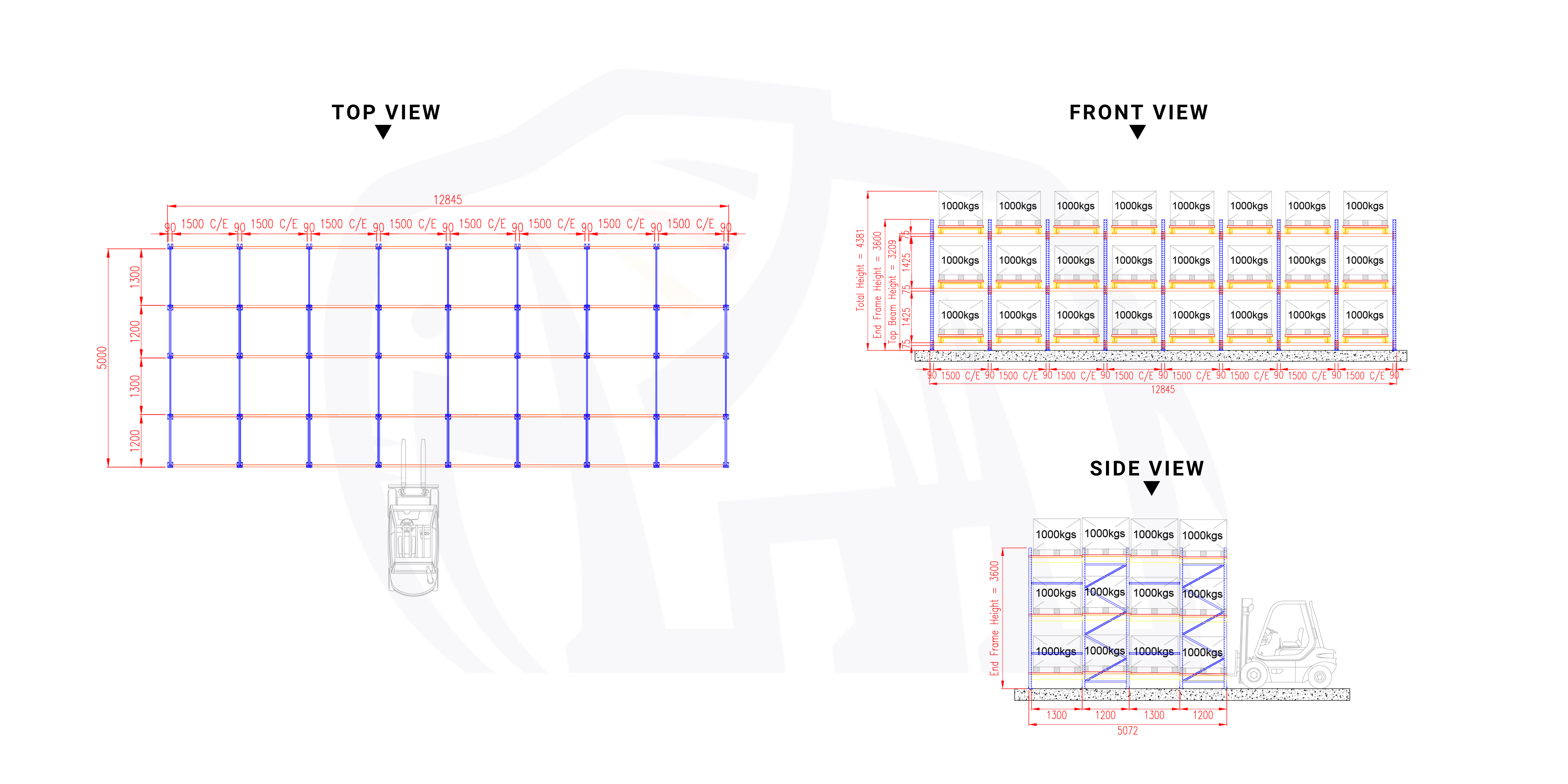
- Layout Design: Work with your supplier to assess the warehouse floor area, ceiling height, truck type and turning radius, and pallet dimensions. The supplier’s layout determines lane depth, the number of levels and aisle positions.
- Load Specification: Specify each pallet’s loaded mass, the permitted positions, and the rated pallet, level, bay and total lane limits using the supplier’s design and load notices. The slab, anchors and resulting load paths also need assessment. Labels and dimensions in an example drawing describe that layout; use your own approved design and load notice.
- Installation and Commissioning: Supplier-led installation and commissioning should check the installed frames, rails, carts or rollers, stops and protection against the design using approved carriers and loads. Follow the specified handover and loading and retrieval procedure.
- Operator Training and Ongoing Service: Ensure forklift operators are trained on the specific loading and retrieval procedure for push back lanes. Schedule periodic racking inspections and agree maintenance and service terms with your supplier.
Cost of Installing a Push Back Racking System
Request a project-specific written quotation. A per-position amount is useful only when its date, capacity, included equipment and installation scope are clear. The installed cost for a specific project depends on lane depth, number of levels, cart or roller type, upright and beam specifications, floor anchoring, protection barriers, installation labour and after-sales service. When comparing quotations, confirm what is included in the price and request a written scope of supply.
Choosing the Right Provider
Selecting the right provider for your racking system is essential for ensuring quality and support. Here are some tips for finding a reliable supplier:
- Research Local Experts: Choose a Malaysian company with experience in push back racking and familiarity with local warehousing requirements.
- Check Certifications and Registration: Verify the provider’s current contractor registration and any relevant product testing or quality certifications.
- Look for Comprehensive Support: Seek out providers that offer consultation, layout design, installation, commissioning, training and after-sales service.
- Compare Quotes with Written Scope: Get quotes from multiple suppliers and compare what each includes: carts, tracks, protection, installation, testing and ongoing service.
Ready to plan your push back racking layout? At HYPERACK, we provide push back racking systems designed for your warehouse requirements. Contact us today for a FREE consultation, and let our team help you evaluate storage options with AutoCAD layout comparisons and a numerical planning estimate. Explore our social media to see real-life projects in action.
Conclusion
Push back racking provides a practical high-density storage option for Malaysian warehouses that operate with one SKU per lane and LIFO-compatible stock. By storing multiple pallets deep and reducing aisle count, it can increase usable positions within the same footprint. The specific benefits depend on your layout, pallet configuration, truck type and operating procedures. Work with your racking supplier to confirm that push back racking suits your storage profile before committing to a design.
How Hyperack Plans Your Racking System?
- Expertise: We dive deep into your warehouse space to determine the best racking configurations tailored to your needs.
- High-Tech Solutions: Our AutoCAD designs compare layout options using your site dimensions, stock and handling inputs, including access constraints.
- Side-by-Side Comparisons: Our planning process allows you to compare layout options easily, helping you make informed decisions.
- Layout and ROI Estimates: We provide numerical layout, cost and ROI estimates using agreed inputs and assumptions, to support planning rather than guarantee a return.
- Customization: We can configure racking around your warehouse requirements, subject to design, component and site constraints.